
The AI Problem
Years ago, in Project Based Learning workshops, I used to say that a good Driving Question shouldn’t be “googleable.” The DQ should not be something answered in a simple search, but students should have to take a deep dive into content before answering it. I would advise teachers to make the context of their project local and/or personal so that students were required to apply the content to themselves and their community.
Now days teachers are talking about designing projects that AI can’t quickly answer. It turns out that is nearly impossible as AI can be coached into any perspective or format and has access to the entire internet. Remember the writing acronym RAFT that we used to teach students? What is your Role, Audience, Format, and Topic?
Today RAFT is an acronym for AI prompts rather than scaffolding for actual writing.
The same advice against “googleable” projects still applies to AI: PBL projects should be community focused and personal to students. Otherwise AI may still be used by students to avoid too much effort when they are not engaged in the work.
Limit Tech Solution
One approach is to return to hand written assignments. By restricting tech access, teachers force students to think and write for themselves. In some cases I think that this can be a suitable approach. Teachers can also require students to demonstrate their writing process through outlines and rough drafts.
The caveat is that if the writing is done outside of the classroom, it still could be AI generated and then copied by hand. Before we start wringing our hands too hard, let’s remember how many students paid other students to write their papers for them in the past. It’s not anything new….
Art Solution
Another version of this philosophy of limiting tech is to tie an art element into the final product. This forces students to apply their content learning in a creative, yet fun context. The art can also be shown off to the community sharing the learning more broadly.
One of my favorite examples of art integrated into the project process is Justin Wells’ Dante’s Inferno Literary Analysis. Rather than being the culmination of the project, the art work happens in the middle of the project deepening students understanding of the epic poem. The art pieces act as scaffolding for the high level literary analysis that the students wrote afterwards. Rather than being just a “shiny” activity, the art is integral to the deep learning.
Motivation Solution
I believe the most effective preventative measure to the lure of AI is creating strong motivation in students to care about the project. If a project focus is truly personal and meaningful, students will commit effort toward quality work (as demonstrated in the video). On the other hand, if the project is perceived as disconnected busy work, then students will flock to the easiest path of completion, AI.
My Honor’s Geometry students are externally motivated and will jump through any hoop, completing any assignment because they care about their grades and competitive standing. They might complain, but they will do the work. Of course, some of them use AI to help with homework, but mostly as a tool to help them understand.
Some of my Algebra I students won’t do anything that is not graded. They want a purpose for the work and many only care about credit in the class. School is something to be endured until they can graduate and take control of their life. They certainly don’t love math for its own sake.
In his book Drive, Daniel Pink argues that intrinsic motivation comes from autonomy, mastery, and purpose. I would argue that in education, the order matters. You can’t start with full autonomy (often called student voice and choice) or you might end up with anarchy. The majority of students will not voluntarily choose to learn most content standards. First, the teacher needs to connect their content to a relevant purpose.
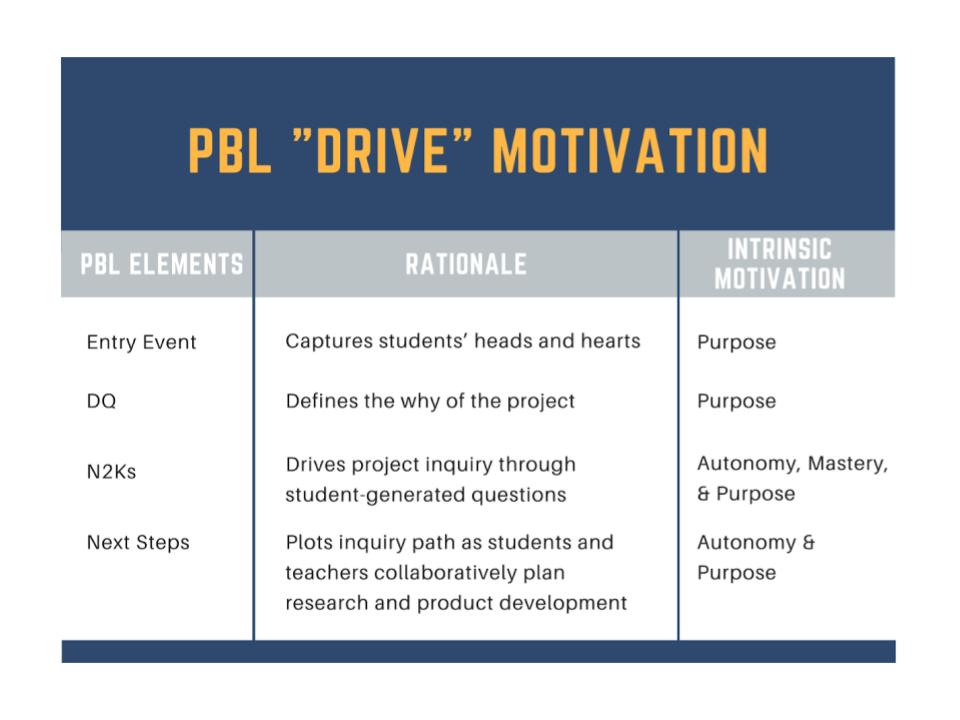
We are still living in an education world that emphasizes content for standardized tests to make sure that all students are at grade level. Standardization is the opposite of agency and purpose. Student tasks needs to be authentic, not isolated skills only. Projects should be tied to academic standards, but not driven by them. It’s counterintuitive, but a project focused on local impact actually leads to deeper learning of content than a pure emphasis on academic standards.
A relevant project that connects students to their community creates an authentic purpose to the content and inspires student to utilize their own creativity rather than to subcontract their thinking to AI.
A PBL project that is embedded in the community with a meaningful impact can motivate students to put their heart and soul into their work. Everyone feels a sense of accomplishment when they give to a collaborative effort that makes a difference. That motivation of purpose shifts students away from the shortcuts of AI to giving their best work that they are proud of!
- What opportunities are there for your students to make a local impact?
- What businesses, non-profit organizations, or community groups could your students work with?
- What local problems might your students help solve?
- Who can your students help?
One thing that AI can never replace is the spark of human connection that comes from service learning that touches local residents. The best way to combat the negative effects of AI is to emphasize our humanity. Let’s teach our students how our contact can help make their world a better place.
Learn with me!
Are you interested in professional development for your school on how to integrate SEL or implement PBL? I would love to have a conversation on how I can help. I am now scheduling summer workshops and book studies. Check out my workshop page or drop me an email at mikejkaechele@gmail.com. I would love to chat and co-plan meaningful PD for the educators at your school.
Would you like to explore more deeply how to integrate SEL into daily classroom activities? Check out my book below for tons of practical ways that can be immediately implemented in any classroom.
Pulse of PBL