Author: Michael Kaechele

  • Why PBL Needs SEL and SEL Connects to PBL

    Maybe you have tried Project Based Learning or Social and Emotional Learning and have not seen the results that you expected. Maybe an entire project crashed and burned. Or students don’t seem to internalize the SEL character building program that your school implemented. Students still struggle with managing themselves and their learning. The sweet spot is a combination of PBL and SEL. Let’s consider 6 benefits of combining PBL and SEL in your class.

    Growing the SEL competencies in students is the “final product” of successful PBL.

    1. PBL moves beyond the misconceptions of SEL

    There are many misconceptions about Social and Emotional Learning. Often educators misunderstand what SEL truly is. They see it either as a set of activities-mindfulness, yoga, breathing, etc- or as a canned character curriculum taught during morning meetings or an advisory class. Instead SEL is a powerful set of competencies that need to be taught, practiced, and assessed throughout the day.

    Rather than relying on a set of coping strategies that address some of the SEL competencies, PBL presents a broad, student-centered framework that provides opportunities to cultivate all of the SEL skills.

    2. The PBL framework naturally embeds the space to practice SEL

    We know that in order for students to develop SEL skills they must be modeled by adults and practiced in authentic situations. PBL pedagogy provides opportunities for both of these to consistently happen. The teacher shifts to a coaching and mentoring role, helping students understand content and demonstrating SEL skills such as persistence through struggle and how to speak respectfully to others.

    In a traditional classroom, students spend the majority of their time quietly listening to a teacher. There is no space in the schedule for them to interact to practice SEL skills. In PBL, children work in teams to solve problems practicing Relationship Skills and Responsible Decision-Making all of the time. They have to negotiate differences, work together on solutions, and articulate their findings in a professional way. The teacher is not taking away valuable class time to practice SEL in an artificial way. Instead students are honing SEL skills while they learn their content through authentic projects.

    3. PBL protocols develop SEL Skills

    Project Based Learning uses many protocols throughout the process to facilitate structured inquiry. After an entry event students generate questions in a Need to Know list. Students begin practicing Responsible Decision-Making as they analyze and evaluate the problem presented to them.

    Discussion protocols such as Talking Circles or Harkness Discussions teach students Relationship Skills of listening intently, communicating clearly, and disagreeing respectfully. I like to include a stipulation that before students make and share their own opinions, they must share perspectives from their investigative research:

    • from the viewpoint of a blue-collar worker who lost their job
    • according to an LGBTQ+ millennial
    • from the perspective of latino mother

    Sharing various perspectives builds empathy and Social Awareness and reveals that most issues are multifaceted and complex.

    4. SEL can be readily assessed during a project.

    It is important that students are consistently assessed (but not graded) on their progress in the SEL competencies. Assessment does not primarily need to derive from the teacher but should include peer and self assessment in the forms of feedback and reflection. When students regularly consider their SEL strengths and areas of improvement, they are encouraged to increase and celebrate their growth.

    Feedback and reflection are integral parts of the PBL process. A simple and efficient approach is for students to set a goal for group work time such as “I can disagree with others without arguing or offending.” At the conclusion have students reflect on an exit ticket, fist to five, or a turn and talk about how successful they were on the goal.

    5. PBL leads to an expanding progression toward equity as students cultivate the SEL competencies.

    Launch the year with a PBL project that explores identity and builds confidence, key components of Self-Awareness. Once students understand who they are and how they fit in the world they will better manage their groups and the projects themselves.

    Their self-assurance leads to students considering the views of others as they become Socially Aware. This empathy leads to stronger Relationship Skills as students respect multiple perspectives in their PBL structured inquiry. This entire process results in a more equitable classroom as students appreciate diversity of thought and approaches to project solutions.

    6. Students become independent and self managing learners

    It has become cliche to talk about student autonomy, voice and choice, and life-long learning. What does autonomy actually mean? We talk about these things all of the time, but how does one truly see students achieve independence?

    As students progress through the concentric circles the payoff is Responsible Decision-Making. PBL leads to students who are able to identify, analyze, and evaluate global issues and local problems independently with empathy toward diverse viewpoints. They understand that that issues are complex and have the skills to investigate various perspectives to reach inclusive and just solutions. The PBL framework presents students with the opportunity to hone their SEL skills to determine equitable outcomes for their communities. This is why SEL skills are the Pulse of PBL!

    Pulse of PBL
    Interested in learning more about how to teach SEL competencies in a PBL framework? Check out my book with practical strategies to teach, practice, and assess SEL skills while students solve meaningful problems in their community.

    Learn with me!

    If you are interested in how your school can use a PBL framework to teach SEL skills. I would love to have a conversation on how I can help. I am scheduling PBL & SEL workshops for this summer right now. Check out my workshop page or drop me an email at mikejkaechele@gmail.com. I would love to chat and co-plan meaningful PD for the educators at your school.

    One and done Professional Development is ineffective. Here’s a great little post about questions you should be asking before you hire a consultant. I would be glad to develop a vision with you!
  • 6 Misconceptions of SEL

    https://casel.org/fundamentals-of-sel/what-is-the-casel-framework/

    Definition of SEL

    Since the beginning of the Covid pandemic, Social and Emotional Learning has become one of the hottest trends in education. But I would argue that it is not clearly understood by most educators. It has been loosely defined and interpreted and ends up being another check off box for schools to say, “Yes, we do SEL.”

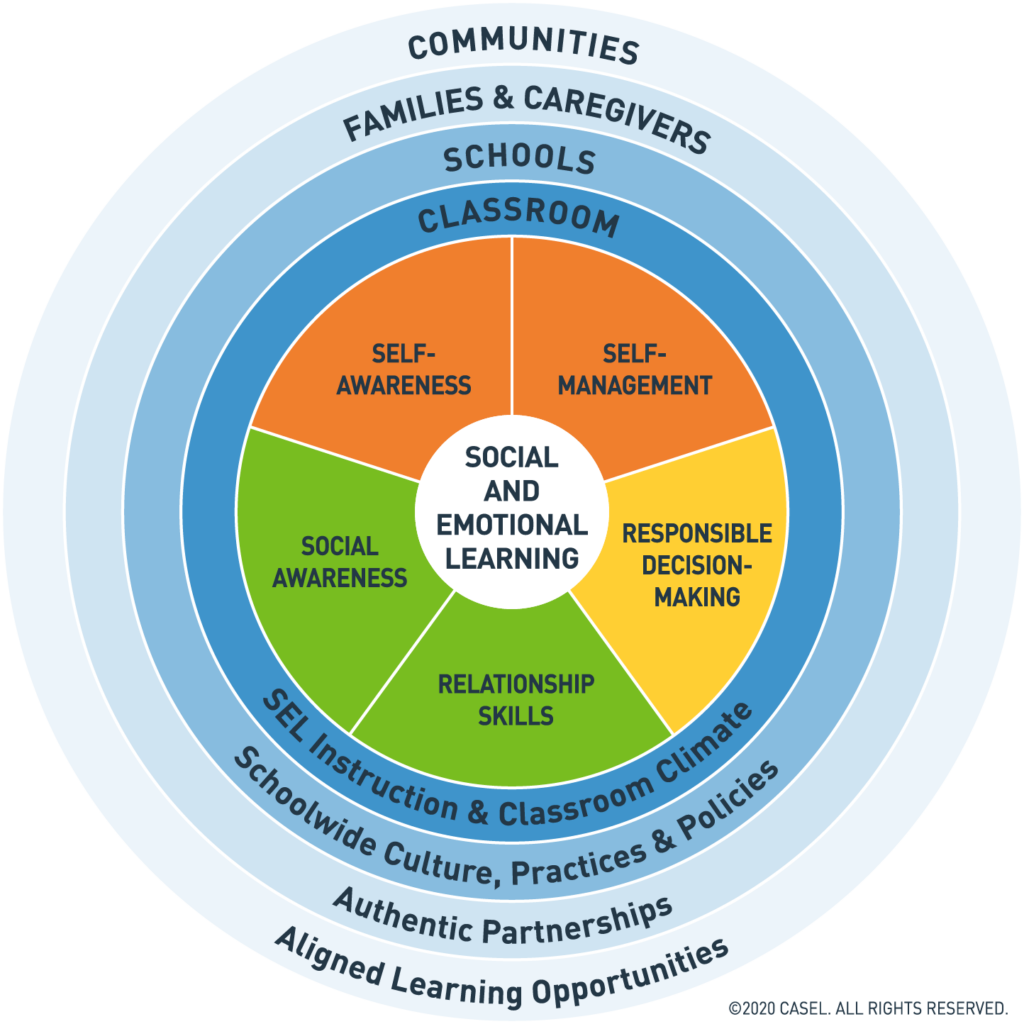
    According to CASEL, “SEL is the process through which all young people and adults acquire and apply the knowledge, skills, and attitudes to develop healthy identities, manage emotions and achieve personal and collective goals, feel and show empathy for others, establish and maintain supportive relationships, and make responsible and caring decisions.”

    casel.org/fundamentals-of-sel/what-is-the-casel-framework

    CASEL lists 5 competencies in their wheel: self-awareness, self-management, social awareness, relationship skills. and responsible decision-making with many bullets that explain what these look like. In 2021, CASEL updated these descriptions emphasizing equity for all as an integral part of SEL.

    It has never been a goal of mine to redefine SEL as I feel that CASEL has done a clear job in that regard, but I do feel like the SEL programs and implementation in most schools does not reflect the totality of what SEL truly is, but is a watered down version.

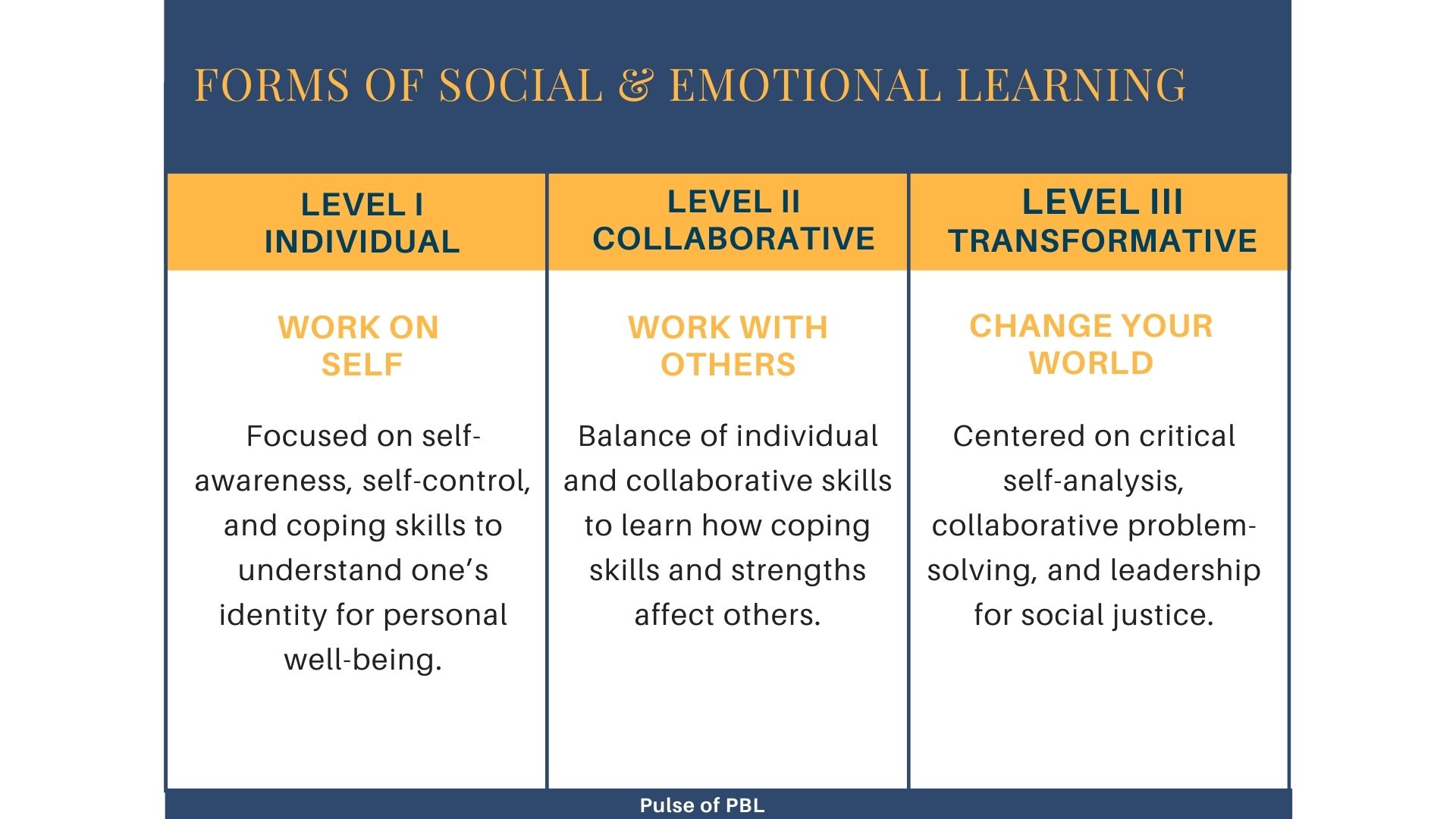
    3 Levels of SEL

    When I reflect on how SEL is taught in schools I see three levels that build on one another. The first level is Individual focusing on managing one’s emotions and appropriate classroom behavior. This is particularly popular in elementary classrooms as students are taught how to regulate themselves and make good choices. Individual SEL instructs students to identify their feelings and then act on them in socially acceptable ways. Students work on improving themselves.

    The second level of SEL is Collaborative where students build upon their Individual SEL skills to get along with others. Students reflect on how their choices and actions affect others in positive or negative ways. They understand the power and synergy of being part of a well-functioning team. In Collaborative SEL, students learn how to successfully work with others.

    The highest level of SEL is Transformative with students utilizing their Individual and Collaborative skills to impact the community. Transformative SEL directs students to apply the 5 competencies toward solving local and global issues including but not limited to discrimination, inequity, and systemic injustice. Students problem-solve issues such as poverty, climate change, ethnic strife, clean water, racism, civil rights, natural resources, and ethical use of technology. In Transformative SEL, students change the world!

    The majority of SEL instruction focuses on Individual SEL missing out on the broader impact that Transformative SEL brings to both the students themselves and society. Now that we have defined SEL and seen the different levels of implementation. Let’s consider 6 common misconceptions about SEL.

    Misconception #1: SEL is equivalent to mindfulness, yoga, breathing, and meditation.

    Many schools are using these type of activities to help students self-regulate. They can be helpful tools for Individual SEL, but are not the actual SEL competencies. What is missing is the communal side of SEL.

    Yoga and breathing don’t address communication, collaboration, and problem-solving. Mindfulness does not teach students how to set goals, organize themselves, and their teammates to achieve their objectives. Meditation may help students calm down in emotionally charged situations but does not build empathy toward social injustices.

    Mindfulness, yoga, breathing, and meditation are not the SEL competencies, but rather are tools that develop some of the SEL skills.

    They miss the holistic picture of teaching students the entire collection of SEL competencies. There are many other effective tools to teach SEL skills beyond these practices.

    Misconception #2: SEL is a waste of academic time.

    Educators who equate Social and Emotional Learning to mindfulness and similar activities may feel like it is a waste of their class time. They have tons of standards to cover and don’t have time for “fluff.” But SEL is not all Kumbaya around a campfire. Research shows that cultivating SEL competencies leads to academic growth.

    Self-Awareness teaches growth mindset pushing students to persevere through academic difficulties. Self-Management develops organizational skills which lead to quality work completed on time. Social Awareness exposes students to multiple perspectives so that they evaluate issues with complexity. Communication and collaboration of Relationship Skills empowers students to express their learning in writing and speech, Responsible Decision-Making enables problem solving of complex academic standards in relevant ways.

    SEL competencies are intricately intertwined with academic skills and are at the heart of deeper learning.

    Spending time, especially early in the school year, developing SEL skills pays dividends for student long-term growth socially and academically.

    Misconception #3: SEL is building relationships and checking on our students’ emotional state.

    Since the Covid pandemic shut down in-person schools around the world there has been a positive focus on trauma informed instruction. Many teachers already focused on relationships to start the year, but it is being emphasized now more than ever. Our students need as many caring adults in their lives as possible. The trauma that students (and adults) have experienced the past few years is real and needs to be addressed.

    SEL and trauma informed instruction are not synonyms; both are critical but they are not the same thing.

    SEL goes beyond trauma informed to teaching students coping skills. Concern for students social and emotional well-being is important, but doesn’t go to the next step of developing the competencies in students themselves. There is also a danger of spending the 1st week of school focusing on building relationships with students and then forgotten as we shift to “normal” school for the rest of the year. SEL needs to be ongoing….

    Misconception #4: SEL will fix my classroom management.

    The truth is that teaching students SEL skills will absolutely improve your classroom culture and environment. But seeing SEL as classroom management is the wrong rationale for implementation. We need to teach SEL for the students benefit of becoming their best selves, not to make things smoother for adults.

    Teachers who believe this misconception narrow in on Individual SEL to improve behavior. They teach students to self-regulate so as not to interrupt class activities and to prevent them from disturbing others.

    Teachers who misuse coping skills as tools for compliance are ignoring Collaborative SEL skills that prosper the entire child.

    With this type of SEL, students rarely reach the level of Transformative applying the skills beyond themselves into the community. SEL competencies will improve how your classroom functions, but the reason we teach them is for growing students for their own benefit.

    Misconception #5: SEL will “save” students of color.

    The use SEL as behavior management to control students is especially problematic with black and brown students. It can be a form of veiled racism ignoring their cultural strengths while imposing middle-class, white values. We see this when SEL is used from a deficit approach to teach students of color to behave but as an asset approach to white students who are prepared for college and careers.

    True equity is built into authentic SEL that honors each student for who they are socially, culturally, and academically.

    In explicit SEL lessons, student become self-experts, using their own cultural values as constructive perspectives to help them flourish. Transformative SEL empowers ALL student to impact the world regardless of their diverse backgrounds.

    Misconception #6: Schools can just purchase a canned, add-on SEL program.

    Whenever I share this last misconception with a group of teacher they laugh in agreement. This is the system’s solution to everything: just purchase a program and use it during morning meetings (elementary) or an advisory class (secondary). Research demonstrates that in order for SEL skills to be effectively taught they need to be modeled by adults and integrated throughout the school day.

    PBL provides a framework that naturally allows all of the SEL competencies to be taught, practiced, and assessed throughout the class.

    We cannot just create an SEL class or block and call it good. SEL skills have to be embedded into everything we do. Character, confidence, and self-esteem are better developed by students engaging in authentic, meaningful work, rather than an artificial, canned program of character-building. That is why I strongly advocate for Project Based Learning to develop SEL skills in all of our learners.

    Pulse of PBL

    Interested in learning more about how to teach SEL competencies in a PBL framework? Check out my book with practical strategies to teach, practice, and assess SEL skills while students solve meaningful problems in their community.

    Learn with me!

    If you are interested in how your school can use a PBL framework to teach SEL skills. I would love to have a conversation on how I can help. I am scheduling PBL & SEL workshops for this summer right now. Check out my workshop page or drop me an email at mikejkaechele@gmail.com. I would love to chat and co-plan meaningful PD for the educators at your school.

    One and done Professional Development is ineffective. Here’s a great little post about questions you should be asking before you hire a consultant. I would be glad to develop a vision with you!