Tag: Social Emotional Learning

  • The False Dichotomy of SEL and Deeper Learning

    Image by hannahlmyers from Pixabay

    Dean Shareski explores the false dichotomy between deeper learning and wellness in Are We Ready to Learn Again. He accurately points out that many schools separate SEL from academic learning. This reminds me that there still exists lingering misconceptions of SEL, many of which originate from school wide SEL programs. Oftentimes these top down initiatives were introduced as a post-Covid reaction rather than by well thought out plan.

    I see two main sources for educators mistakenly segregating SEL and content learning. First, SEL is usually taught separate from content. In elementary schools, it is a 15 minute slot in the already packed daily schedule. In secondary, it is relegated to an advisory period a few times a week.

    The second reason that educators separate SEL from deeper learning is they have a partial understanding of what Social Emotional Learning truly is. Let’s explore each of these reasons and why this is more than just an exercise in semantics.

    Compartmentalization

    As a response to the student isolation of the pandemic practically every school added some sort of SEL instruction. The pendulum of educational priorities rapidly swung from Common Core and standardized testing to connecting and meeting each student’s wellness needs, seemingly from content to SEL.

    The problem in many schools is that teachers were not prepared for nor trained in how to effectively model and teach SEL skills in their classroom. It was easier to “check the SEL box” by purchasing curriculum and making it a mandatory part of a student’s schedule. As might be expected, some teachers enthusiastically embraced this shift, while others quietly ignored it seeing SEL as the “flavor of the month” initiative that will fade away if they wait long enough.

    It is no wonder that many educators separate SEL from deeper learning when it is siloed as a separate class.

    SEL can not be limited to advisory time or a fifteen minute slot in the elementary schedule. While administrators may have the best intentions, a canned SEL curriculum compartmentalizes it as a “subject” that is separate from the rest of school. The students also perceive this disconnect between SEL and the rest of their classes. Therefore both teachers and students may view Social Emotional Learning as “fluff” and not pertinent to “real” school in any meaningful way.

    A Better Definition of SEL

    A second problem with SEL is a limited definition that only sees it as focused on students well-being. Many educators equate SEL with specific practices such as mindfulness, breathing, and yoga. It is seen as an individual coping strategy to deal with stress or strong emotions. Others conflate SEL with trauma informed instruction and focus on connecting and meeting each student’s mental health needs.

    While all of this is helpful and important, it should not be defined as Social Emotional Learning. Mindfulness, breathing, and yoga are helpful tools to develop SEL skills, but are not the actual competencies themselves. Trauma informed instruction is a critical piece that our schools need but is also not synonymous with SEL.

    SEL should not be limited to students experiencing trauma or who struggle to get along socially with others. That is deficit thinking. SEL skills need to be cultivated by everyone, including adults, over a lifetime. No one masters them all. CASEL defines SEL as:

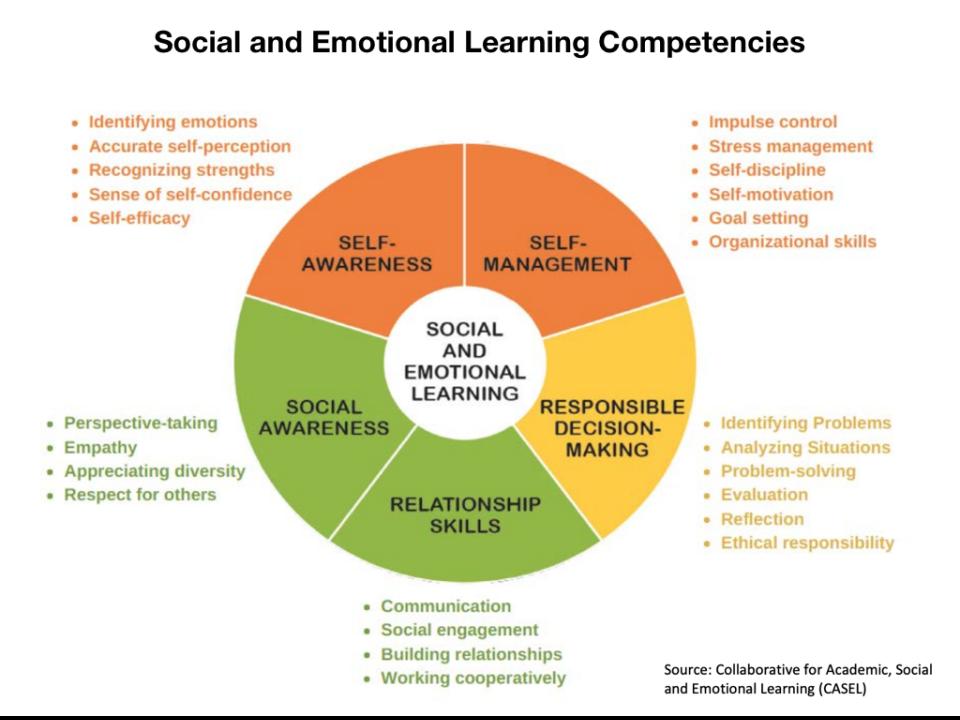
    “Social and emotional learning (SEL) is an integral part of education and human development. SEL is the process through which all young people and adults acquire and apply the knowledge, skills, and attitudes to develop healthy identities, manage emotions and achieve personal and collective goals, feel and show empathy for others, establish and maintain supportive relationships, and make responsible and caring decisions.”

    CASEL

    This more complete definition of Social Emotional Learning as a complex set of skills and characteristics demonstrates that coping skills and mental health are elements of SEL, but not the whole picture. SEL skills include communication, empathy, collaboration, and problem solving. SEL is not limited to student trauma but encompasses many skills integral to deeper learning.

    Why SEL Matters

    Students need SEL in school, but not in the way that educators often perceive it. With an accurate understanding of how the SEL skills relate to core content exploration, students should be practicing them while engaging in deeper learning. Let’s go beyond SEL lessons in advisory to practicing skills all day long.

    Rather than being separate from content instruction, SEL provides the skills that enable students to research deeply, discuss civilly, empathize, and apply learning to their world. In order to be effective, SEL skills must be taught, practiced, and assessed all of the time.

    We know that effective SEL instruction must be modeled by adults and integrated throughout the day.

    If you know anything about me, then you know that I wholeheartedly embrace Project Based Learning as the perfect structure to teach SEL skills and content simultaneously. We need to model SEL daily and practice its competencies throughout the class as students collaboratively work on structured inquiry solving complex problems.

    Learn with me!

    Would you like to explore more deeply how to integrate SEL into daily classroom activities? Check out my book below for tons of practical ways that can be immediately implemented in any classroom.

    The ideal way to improve SEL skills for students is to start with the adults. Districts should provide PD where teachers explore their own SEL strengths and weaknesses, modeling strategies that can be used in the core classroom.

    Are you interested in professional development for your school on how to integrate SEL? Of course, I highly recommend PBL as the ideal framework to use. I would love to have a conversation on how I can help. I am now scheduling workshops and book studies for spring and summer. Check out my workshop page or drop me an email at mikejkaechele@gmail.com. I would love to chat and co-plan meaningful PD for the educators at your school.

    Pulse of PBL

  • 10 SEL ideas to launch the year

    Identity Inventory

    As we attempt a return to normal in our classrooms (whatever that means) teachers realize the value of continuing to focus on Social and Emotional Learning. This really isn’t new as most teachers start off any school year with team and culture building activities. But 2020 brought Covid and a refocusing of black lives with the tragic murders of George Floyd and Breonna Taylor (among others). On top of this is the trauma of poverty that twenty percent of the children in the US experience daily. Educators are reflecting more than ever on the mental psyche of their students due to national or personal trauma.

    So here are ten ideas for how to start the year with SEL…and maintain a focus on SEL throughout.

    1. Mood Meters

    Free Download

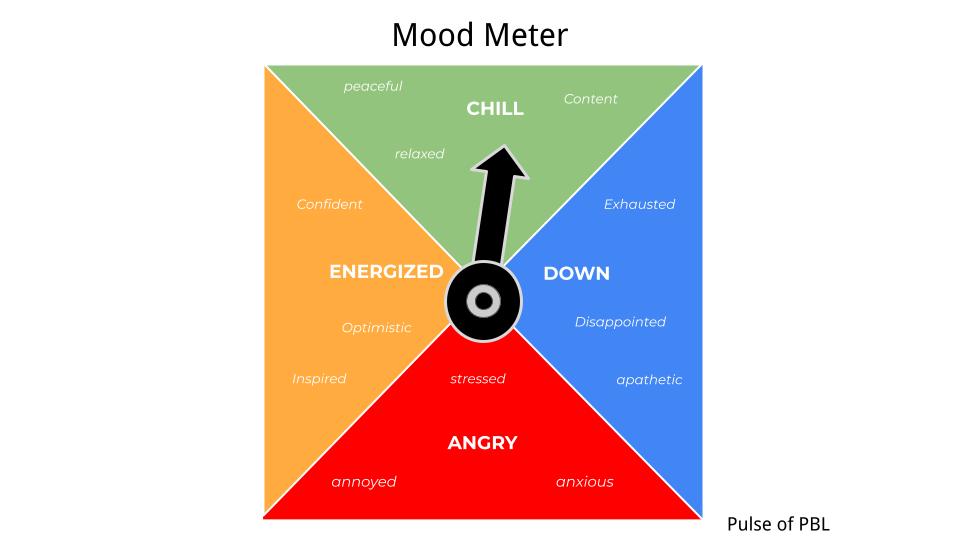
    One simple way to “check in” with students is to use a Mood Meter to have students describe their feelings at the moment. This is teaching students to identify their emotions, which is the first step before they can regulate them. It also is formative assessment for the teacher on where students are at before jumping into an activity. An alternative is to use Rubber Bracelets, which could be adapted for remote learning by having students use a color wheel.

    2. Highs and Lows

    I always start class by having students share “highs and lows” which means basically anything that they want to share from important life events to “I had Taco Bell last night.” I used to call this “Good News” in our class and focused on sharing positive, uplifting things, but then I noticed students wanted to share painful things and would say, “This isn’t really good news, but my grandmother is in the hospital.” I realized that what was important for building safe community was sharing any news that was important to students. I truly believe this first few minutes of every day created the culture for the year.

    3. Identity Reflection

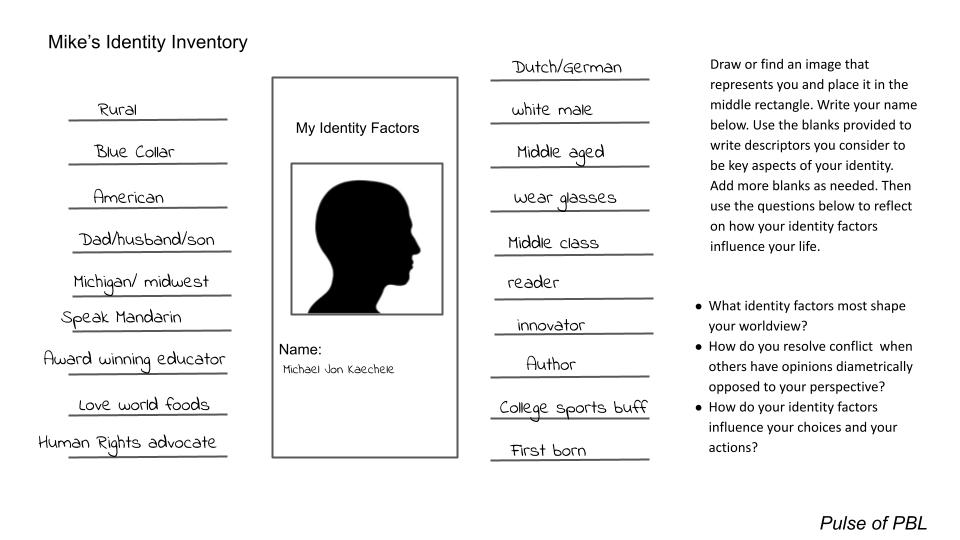
    There are many ways to get to know students and for them to learn about each other. If we want to go deeper than the typical icebreaker questions and be culturally responsive than we need to talk about student identities. Two excellent ways to explore identity are the Identity Inventory (example at the top of this post) and The Paseo or Circles of Identity These activities call for deep reflection on how students see themselves and the influences in their life. These may be too personal to share out loud, especially during the first week, but it may be appropriate to ask for volunteer sharing with you (never mandate it).

    Another way to talk about identity is to show how visually biased we can be. Use 10 pics before and after people were asked to smile and 6 photographers, one man to discuss how what we see and how people portray themselves is only a small part of who they are.

    4. Build Relationships

    As we get to know our students and community, we can go deeper by helping students realize how they prefer to work in groups and with each other. You can use an online version of Meyers Briggs personality test or the Compass Points activity. This further builds their Self-Awareness of who they are, but also leads to Relationship Skills as they can communicate how they work with team members BEFORE conflict arises in their groups.

    As the teacher my main goal at the start of the year is to get to know each student. This can be challenging at the secondary level with so many kids. This 360 Spreadsheet is a way to track the data that you learn about your students so that you can use it to guide your instruction. A quick visual check will show you which students you are not spending enough time getting to know.

    5. Mini-PBLs

    While addressing SEL, we should also be introducing some protocols and procedures so that students become familiar with them. The Selfie Project is a way to get to know students and model the PBL process in only 1 hour. Start off with an entry event of sharing slides about you; introduce the Driving Question: “Who am I?”; spend 2 minutes on Need to Knows; and then turn the kids loose to create their own selfie slides (inquiry). End class with 30 second presentations of who they are. You have just modeled the PBL framework so that when you use it with content, students are already familiar with it.

    Whether you are remote or in person you are going to use some technology tools. Instead of direct instruction, use a mini-project like above to introduce it. Here is an example for GDocs Mini-Project. This process can be used for any tech tools that you will use with the DQ of “How do I use….?”

    6. Connect with Parents

    Whether you are in the same room or far away from students, it is important to make early positive communications with all parents. Especially this year make it a priority to have regular communication with all parents. Take the first step of a personal phone call for each student within the first month of school. Find strengths to share early in the year to build a positive rapport with parents and let them know that you are working with them.

    7. Team building

    Most team building involve students either touching each other or sharing materials, which is not going to work with Covid. Here’s a couple of activities with no contact at all. Write it / Do it has one student observe an object and then describe (verbally or in writing) it to a partner who has the materials and must build it. Materials are usually things like Legos or classroom supplies. To adapt for Covid, use colored pencils or crayons and have students draw on graph paper printed colored designs.

    Another favorite of mine is to tell a One Word Story I ask students to respond to the question: “What is the meaning of life?” Math teachers might try Bing, Bang, Buzz. Count to 20 is another non-contact icebreaker that can be particularly challenging in a video call.

    No matter what option you choose, it’s just a fun activity unless you have initiate a reflective debriefing. Show students an image of the CASEL competencies with the subcategories. Ask them which of these skills they needed to use to be successful at the challenge. Discuss how they will need to use these same skills for projects in your class through out the year. Importantly, come back to the activity as a reminder when students are struggling with a group problem.

    8. Create Class Norms

    Many teachers do this, but I am not convinced that they do it well. This process has to be focused on the kids and honor their voices. Creating and posting class norms is only a piece of the process. What is vital is referring to them whenever necessary, reviewing them weekly, and modifying as required. Class norms should be a living document that grows as students get to know each other.

    Another option to consider is using talking circles (can be done virtually) to Create Group Contracts. This is one of the first steps of Self-Management and building Relationship Skills in your class.

    9. Introduce Routines

    Introduce whatever structures that you plan to use this year. A simple See, Think, Wonder can be used at any grade level and content area to help students be more observant and break down a problem. Students are equipped with a process for Responsible Decision Making.

    I have made some templates for Visible Thinking Routines from Harvard Project Zero in Google Docs and Slides that work great for remote use. Check out this post for more info. and free access to the templates.

    10. Teach Content

    I see many teachers making comments like, “I am not touching content for two weeks.” I think that they are missing an opportunity. One of the dangers of SEL instruction is to treat it as an add-on to your classroom. Don’t treat it as something separate from learning. SEL and content can and should happen at the same time! This doesn’t mean that you can’t do some fun team building activities. What it does mean is that you should attempt to frame everything as essential to your class.

    Connect the skills that students are learning to how they will help students be successful in your class. Identity could be the basis of your first project in English Language Arts. Consider a culturally relevant project addressing Antiracism in social studies. For math, you might introduce a tool like Desmos through a Getting to Know You activity. Some open ended experiments can teach students the scientific method and build community.

    You can teach routines, build community, and establish procedures while starting to introduce the standards of your curriculum. Don’t fall into the trap that content can’t be fun or student-centered. This will be a year like no other, but no matter where and how your class takes place this year, you can address SEL in meaningful ways.

    Learn with me!

    Are you interested in professional development for your school on how to integrate SEL or implement PBL? I would love to have a conversation on how I can help. I am now scheduling summer workshops and book studies. Check out my workshop page or drop me an email at mikejkaechele@gmail.com. I would love to chat and co-plan meaningful PD for the educators at your school.

    Would you like to explore more deeply how to integrate SEL into daily classroom activities? Check out my book below for tons of practical ways that can be immediately implemented in any classroom.

    Pulse of PBL