
Social Emotional Learning and Project Based Learning are two of the hottest trends in education right now. Their popularity is due to the pendulum swinging back from the previous obsession with standardization and assessment dictated by NCLB and RTTT to more holistic education. Yet neither SEL nor PBL should be seen as fads, but as necessary and permanent shifts in pedagogy.
SEL is constantly happening in every classroom but is often part of the hidden curriculum. Teachers need to make SEL visible and intentional. Many schools are implementing specific plans for SEL as a stand alone curriculum. But as Frey, Fisher, and Smith advocate in All learning is Social and Emotional,
“What’s needed, and what’s far less common, is for schools to amplify the principles SEL programs introduce to make them the fabric of the school itself. In order for SEL to have a lasting and sustained effect, it needs to be integrated into the academic mainstream rather than remain on the periphery.”
SEL should not be another thing added onto teachers’ plates, but rather is most effective when integrated into classroom culture and routines.
PBL experts have long advocated that students should be learning skills in the classroom simultaneously with content knowledge. There are many labels for these skills:
- Soft Skills (which makes them sound weak)
- College and Career Readiness (but many are about quality of life, not making money)
- 21st Century Competencies (even though they aren’t new; cavemen used them)
- Success Skills (PBLWorks’ term)
- School Wide Learning Outcomes (New Tech Network’s term)
- Character Framework (Expeditionary Learning’s term)
SEL is the best terminology and framework for the set of skills that PBL experts agree should be integrated into projects. The following table shows how CASEL’s SEL Competencies can be naturally embedded into High Quality PBL.
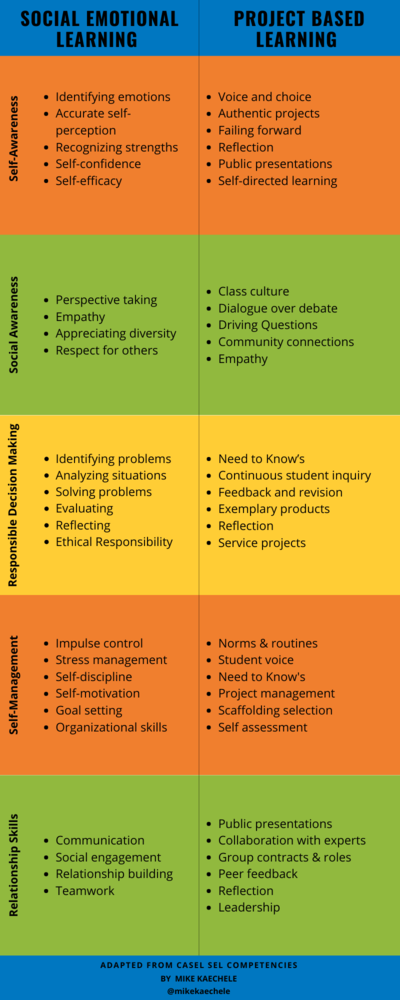
Free PDF Download of Chart
Self-Awareness
Self-Awareness is accurately perceiving who you are as a person and developing confidence based on your individual strengths. Many students lack a belief in their abilities or have skills that are not emphasized in traditional classrooms. Project Based Learning gives all students the opportunity to gain confidence by creating meaningful work.
PBL honors each student’s unique characteristics. Through voice and choice, students recognize and use their strengths in what products they create and how they demonstrate their learning. Students build confidence by choosing group roles based on their strengths. PBL is built upon a growth mindset. Students use design thinking protocols to plan solutions, creating a culture of failing forward through iterative stages. They learn that mistakes are not permanent, but part of the routines of working toward success.
Reflection throughout the project process helps students see their progress and personal growth. Public presentation of their work encourages students and creates a positive self-perception. Students learn to advocate for themselves in PBL by requesting workshops from the teacher when needed. Most importantly the PBL framework teaches students how to learn, so they develop the skills to pursue any topic that they are passionate about on their own.
Social Awareness
Social Awareness is considering others’ perspectives and having empathy for people from diverse backgrounds and viewpoints. Today’s world has become polarized with people talking over each other, rather than listening and working towards compromise. High quality PBL forces students to consider multiple perspectives before working toward solutions.
Every teacher begins the year by establishing classroom norms. In PBL these norms are focused on respecting each other, even when we disagree and on how to function well in a group. Since students spend the majority of their day working together, they will consistently have different opinions. These are opportunities for them to learn how to navigate conflict peacefully. Each student’s voice should be heard and respected throughout the project.
Projects start with a Driving Question (DQ) to engage students and frame the anticipated learning. Students should be investigating multiple viewpoints before coming to any conclusions. Community members from a wide variety of backgrounds and experiences should be embedded into the process. Students should see that complex problems in society do not have simplistic, one-sided answers.
A project on stewardship of the environment, for example, would consider not only the negative effects of industrial pollution and land development, but the positive effects of jobs and economic benefits created by businesses. Students would be challenged to hear all sides and balance the needs of everyone in their final solutions.
Responsible Decision Making
Responsible Decision Making is making positive choices based on ethics, safety, and norms. The SEL framework emphasizes student behavior in the classroom, whereas PBL applies it more globally to issues outside of themselves. But the skills are the same in each case, with PBL using Social Awareness to drive this decision making.
The Driving Question launches a project with a focus on an authentic problem. Students then generate a list of “Need to Know’s” (N2K’s) of information and skills necessary to generate a solution. From the N2K’s, students with the guidance of the teacher plan “Next Steps” of how they will conduct research into the problem. This whole process requires identifying and analyzing problems at a deep level.
Since PBL is student-driven, continuous inquiry is embedded as students evaluate both resources and the Driving Question at every stage. Students engage in feedback and revision protocols such as gallery walks and the tuning protocol as they evaluate each other’s work. This peer feedback leads to exemplary products in their final solutions to the Driving Question.
In PBL, students reflect on both the skills that they are learning and their behaviors in their groups. There are “teachable moments” to talk about ethical responsibility on a daily basis. Taking ethics to the next level, service projects give students the chance to make a positive impact in the community. PBL creates a strong connection for students between personal and civic responsibility in their neighborhoods and beyond.
Self Management
Self Management is regulating oneself to manage and achieve goals. Project management is a key skillset in PBL within which self management is practiced and attained. The teacher creates a climate for students to manage themselves with the norms and routines mentioned under Social Awareness. Students become self-motivated when they exercise their voice to direct their learning as they explore their passions in the N2K’s and Next Steps protocols.
The classroom should be a safe space for students to develop project management skills. In PBL, students organize their groups through contracts that define appropriate behavior and define work roles. They can use tools such as scrum boards and team calendars. Students should set goals as a team and learn to hold each other accountable for completion. Older students can use online tools such as Trello to organize and younger students can use posters or bulletin boards for the same purpose.
Students also learn self-management by choosing the appropriate scaffolding and tools that they need to complete their work. Teachers can give menus of options and students can choose what works for them. Finally, a key element of PBL is self assessment through reflection. Students can compare their work to rubric descriptions and exemplars. They should be reflecting on their content learning and the SEL skills that they are developing throughout the PBL process.
Relationship Skills
Relationship Skills are the ability to maintain healthy relationships with diverse people through communication and cooperation. Since PBL involves significant time spent working in groups, it is the perfect structure to develop Relationship Skills
Communication is one of the most fundamental skills developed in PBL. In traditional classrooms, students often sit passively listening most of the time. In PBL, not only are students constantly communicating in their groups, but they give professional presentations to their class and the community. Community experts are brought in and students collaborate with them to develop solutions to the DQ.
As mentioned previously, group contracts and student roles help students learn how to interact with each other in productive ways and invoke teamwork for successful completion of their goals. Feedback and revision protocols teach students to both give and accept peer feedback on their products. Reflection throughout the project on their group dynamics gives students opportunities to identify and solve relationship challenges.
Conclusion
SEL should not be another add-on program in schools. PBL is the perfect framework to teach SEL competencies seamlessly. This student-centered approach allows students to develop their skills in a safe environment under the reflective guidance of their teacher. SEL and PBL -the perfect marriage ’til death do they part.
Questions? Interested in SEL and PBL Consulting? Connect with me at michaelkaechele.com or @mikekaechele onTwitter.
