Tag: Project Based Learning

  • It’s Past Time to Eliminate Standardized Testing

    circa 2014

    I have been against standardization for a long time. Standardized testing is a billion dollar industry in this country. So apparently it won’t go away anytime soon, which is a pathetic shame. The companies that run the tests and create all of the test prep materials have strong lobbyists who spend millions to influence policy at both the state and federal level. So as usual, business pursuits have a larger influence on policy than the viewpoints of experts, the educators in the field.

    Mandated, high stakes testing shouldn’t just be skipped this year, but permanently replaced with authentic projects.

    Therefore I am deeply disappointed in the Biden administration’s mandate for states to test students this spring. But I am not surprised. Poor education policy is one of the few consistently bi-partisan agendas in the United States. Going back to Reagan, every president and their Department of Education, has looked on public schools negatively, needing to be fixed. Republicans, exemplified by Betsy DeVos, seek to demonstrate public education’s failures to advocate for charters or vouchers for private schools. They also hate teacher unions. Democrats, while saying they want to improve failing schools, hold schools accountable through rigid, biased testing.

    “Accountability is a word used in the field of education to scare educators into spirit-murdering dark children.”

    Dr. Bettina Love

    Think about it. We just went from Bush’s utopian nonsense of No Child Left Behind (NCLB) to Obama’s Race to the Top. Until we fix all of society’s ills and inequality there will be children left behind. The major reason that children are left behind is the caste system in the United States that divides people into different classes with different benefits. Education alone cannot fix this societal problem.

    Obama’s analogy of Race to the Top is antithetical to equity. Every race that I know of has winners and losers. So Democrats are hypocritical when they want to use testing for equity. Let’s not forget that Biden was part of the Obama team and seems reluctant to find a new path. There are definitely equity issues in public education, particularly in funding structures that favor wealthy suburban districts over rural and urban areas in many states.

    It’s not that public education is perfect. It’s that the government solutions of standardized curriculum, testing, and accountability don’t work.

    It’s been 20 years since NCLB launched the profitable obsession with standardized testing. At best it identified inequity between different learners in schools, but offered no solutions. We now understand the problems in education and continued testing will have zero effect on solutions. Instead we need to shift pedagogy.

    I recently read Dr. Yong Zhao’s An Education Crisis is a Terrible Thing to Waste. He expounds on the need for schools to shift to:

    • Relevant learning
    • Student agency and autonomy
    • Personalized learning
    • Product-oriented entrepreneurial schooling
    • Globalized learning beyond the classroom

    Basically PBL done at a high level, seated in the community with tons of student autonomy. The book gives many examples of what this looks like in different settings around the world. And all of this was written before Covid-19 shocked the world and radically challenged the system by forcing virtual, hybrid, or socially distant learning. Many others have written about how unethical, unhealthy, and unfair standardized testing is during a global pandemic. It is stressful for educators and students alike with no positive benefits. While agreeing, I want to go further and get rid of it all together.

    What if we took the time and money wasted on testing and test prep and used it to radically shift schools to student-centered Project Based Learning?

    At the same time that Biden was announcing that states must continue testing, Edutopia released new research supporting PBL as a better way forward. Covid-19 is a chance to re-evaluate everything about the education system. We know what’s broke. We know testing won’t fix it. PBL offers a better path for all students. True leadership would take this opportunity to make a major shift in the pedagogy of schools in this country. All students deserve the opportunity to pursue their own passions in meaningful ways. The best way for them to learn the skills that they need to be successful is by doing authentic tasks in their community and beyond.

    While educators obviously cannot depend on the federal government to make the right decisions regarding testing and pedagogy, we are not powerless. We can choose to ignore test scores and shift to meaningful learning experiences with our students. When parents are brought into conversations about pedagogical shifts to Project Based Learning, they will be supportive and students will thrive. It’s on us to make this happen!

    Questions? Interested in a PBL workshop or consulting?  Connect with me at michaelkaechele.com or @mikekaechele on Twitter.

    LOVE, B. (2020). We Want To Do More Than Survive: Abolitionist teaching and the pursuit of educational freedom. Boston, MA: Beacon.

    Zhao, Yong. EDUCATION CRISIS IS A TERRIBLE THING TO WASTE: How Radical Changes Can Spark. TEACHERS COLLEGE Press, 2019.

  • LGBTQ+ Students Need Allies

    Usually on this blog, I share my expertise around PBL and SEL from my personal experience. This post will use some personal stories, but LGBTQ+ is an area of growth for me and I am in no way an expert on the topic. I feel it is important to share my journey and point toward others who are experts because we don’t talk about LGBTQ+ issues enough in education. And these issues are 100% Social and Emotional Learning in the areas of Self and Social Awareness.

    This year I have been attending a series of virtual workshops from the Michigan Department of Education supporting LGBTQ+ students in our schools. We had a panel of LGBTQ+ students from around the state share their experiences with us. This past week we had as our guest Owen Bondono, the 2020-21 Michigan Teacher of the Year, who led us through some resources and answered questions. Owen is the first trans teacher of the year in our state. So in “old school” blogging style, here are some reflections on what I am learning.

    Harassment of LGBTQ+ Students

    I grew up in a conservative, religious, rural community. Most people that I knew opposed LGBTQ+ people for religious reasons. Most LGBTQ+ people were not “out” but everyone knew who they were. We were often judgmental, but mostly we pretended like LGBTQ+ didn’t exist in our community.

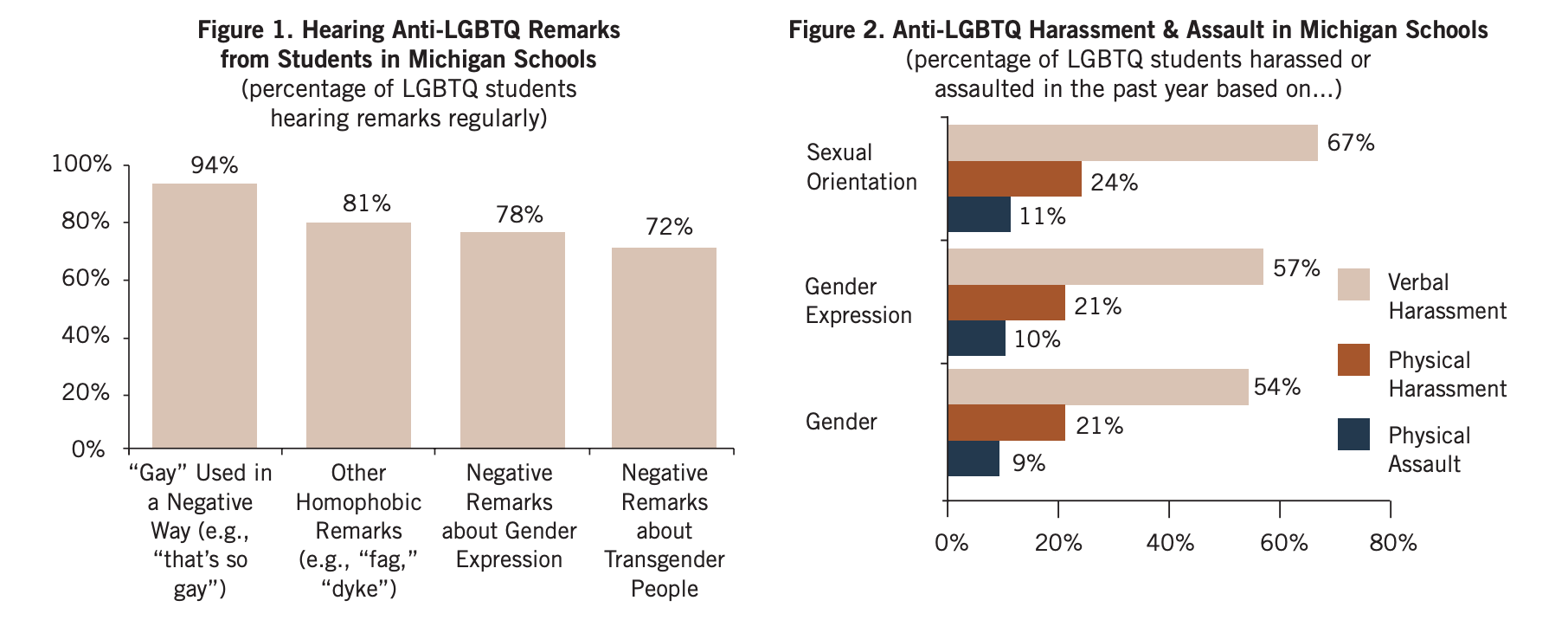
    Nationally around 13% of students are LGBTQ+. So as Owen said in our workshop, “Unless you have a magical class with less than 10 students, then you have LGBTQ+ students.” Based on current surveys in Michigan (and I sincerely doubt the numbers are much different where you live), LGBTQ+ students are huge targets of bullying, harassment, and assault in schools. Unfortunately this includes teachers as the perpetrators. This is not ok. I don’t care what your personal beliefs are; we cannot tolerate prejudice and hate from students or adults in our schools toward LGBTQ+ students. We have professional and legal obligations to make schools inclusive and safe for all students.

    Via GLSEN 2019 National School Climate Survey

    A Culture of Safety and Belonging

    I was a founding teacher at a comprehensive Project Based Learning school that functioned as a lab school for the county. We bused in kids from 20 districts representing urban, rural, and suburban communities. It did not take long to realize that we had a high percentage of LGBTQ+ students at our school. They were not recruited, but I think we gained a reputation as being an accepting, safe space for all students. We were by no means perfect. We definitely had students who were homophobic and transphobic, but our culture was inclusive and did not tolerate hateful speech. Based on the conservative communities that our LGBTQ+ students lived in, I can surmise that they did not feel as safe at their home districts.

    In the fall of 2012, students completed the #MyParty election project where they created their own political parties based on issues that mattered most to them. Since my students came from such diverse areas across the county, we had all kinds of party platforms advocating for and against pretty much any issue imaginable. But one issue that stood out was gay marriage (not legal in our state at that time). No matter if the students were conservative, moderate, or liberal on other issues, they agreed in marriage equality. Students who personally opposed homosexuality for religious reasons still supported LGBTQ+ rights for marriage equality.

    For the culmination of the project, we invited in a group of local state representatives. They were almost entirely Republican, because that is the voting demographic of our area. The students played 30 second commercials for their party and gave two minute stump speeches. When it was over the Representatives rushed me and only wanted to know one thing: Are all young people really this supportive of gay rights? They were literally in shock hearing this from the kids in their communities. You better believe that I told my students this story the next day! This is the power of student voice in action, influencing the leaders of our state.

    Pronouns

    I learned a ton about LGBTQ+ issues from my students. One day that stands out is when Cam, who identified as non-gender, informed me that their preferred pronouns were “they/them.” I had never heard of this before, and my initial reaction was thinking that it was really strange and made no sense because everyone knows those are plural. I did some research and began to learn more about different LGBTQ+ terms. I am thankful for Cam’s bravery to teach me about what mattered to them.

    More recently it has become common for people to identify their preferred pronouns in certain situations including email signatures and social media descriptions. To be honest, I have resisted this trend, judging it as performative. But what I have learned the past few weeks, is that it can be powerful for LGBTQ+ students to know that teachers are allies to them. Currently as a teacher in a virtual school that has LGBTQ+ students (some identified and I assume many others who are not), I have struggled with how to show support for them. That’s when I realized that by including my pronouns in my communication, it’s a small signal to LGBTQ+ students that I respect their right to choose their pronouns. So I have made this subtle change, but it is too soon to report any student feedback yet.

    Again, Social and Emotional Learning includes students having Self-Awareness of who they are and Social Awareness to accept those around them with different viewpoints. So what can we do as educators to make sure that our schools and classrooms are safe for all students, especially LGBTQ+ ones? Some basic things that everyone can do:

    • Use students’ preferred names, regardless of whether or not it is their birth or legal name.
    • Use students’ preferred pronouns, regardless of whether or not it makes you uncomfortable.
    • Include literature that represents LGBTQ+ characters in your school and classroom libraries.
    • Zero tolerance of homophobic or other discriminatory language or actions toward LGBTQ+ students, including from adults. (this is a legal responsibility)

    Resources

    As I stated above, there are many out there who are more educated than me on this topic and you should learn from them.