I saw a Facebook post this week where a teacher was asked in an interview, “What’s more important, teaching content or skills?” The extensive thread of comments were fascinating with people taking all kinds of positions from choosing one side, calling it a stupid question, or pointing out that it’s not an either/or question. While I can agree that it seems like some kind of gotcha question for an interview, I do have a strong opinion on this one (No surprise there!).
I will always argue for skills over content, specifically Social and Emotional Learning skills. But let’s start by only considering core content skills vs. content. The standards that have been ordained from on high for us to teach in schools represent such a minute fraction of the knowledge of the world. New human understanding grows exponentially every second. Textbooks need to be updated due to errors and better understandings of the world. Something as crucial as how the human brain works was barely understood 30 years ago. Therefore I would argue that the most important standards are the ones focused on skills such as problem-solving, reading and writing fluency, critical analysis, and scientific reasoning.
In making the argument for skills over content, I am not saying that content does not matter at all. Of course it does, but it is less vital.
- A student with strong observation and reasoning skills can study the background of a science topic and design an experiment to test a hypothesis. Better yet, they know what to do with unexpected results and how to iterate to develop a theory.
- When a student has number sense and mathematical reasoning, they can solve new problems without having to be taught algorithms first.
- A student who knows how to interpret analogies, metaphors, and similes can apply their skills to poetry from an author that they have never read previously.
- When a student knows how to evaluate primary sources for point of view and author intention, they can apply historical thinking to present day current events.
These core content skills are transferrable to any career or learning path.
SEL competencies may seem even more removed from content, but I would argue that they are the most important skills of all. Long after students forget the content of the class, we still want them to be quality humans. Our dream for students is that they would be Self and Socially Aware, recognizing strengths in themselves and in the diversity of the world around them. We want to develop students who build strong relationships with colleagues, family, and friends. The world needs future leaders who can resolve differences through respectful negotiation, not senseless violence. Complex issues such as climate change, global inequity, and socio-political power struggles require Responsible Decision-Makers who consider multiple perspective and move in directions to benefit all of humanity, not just wealthy nations.
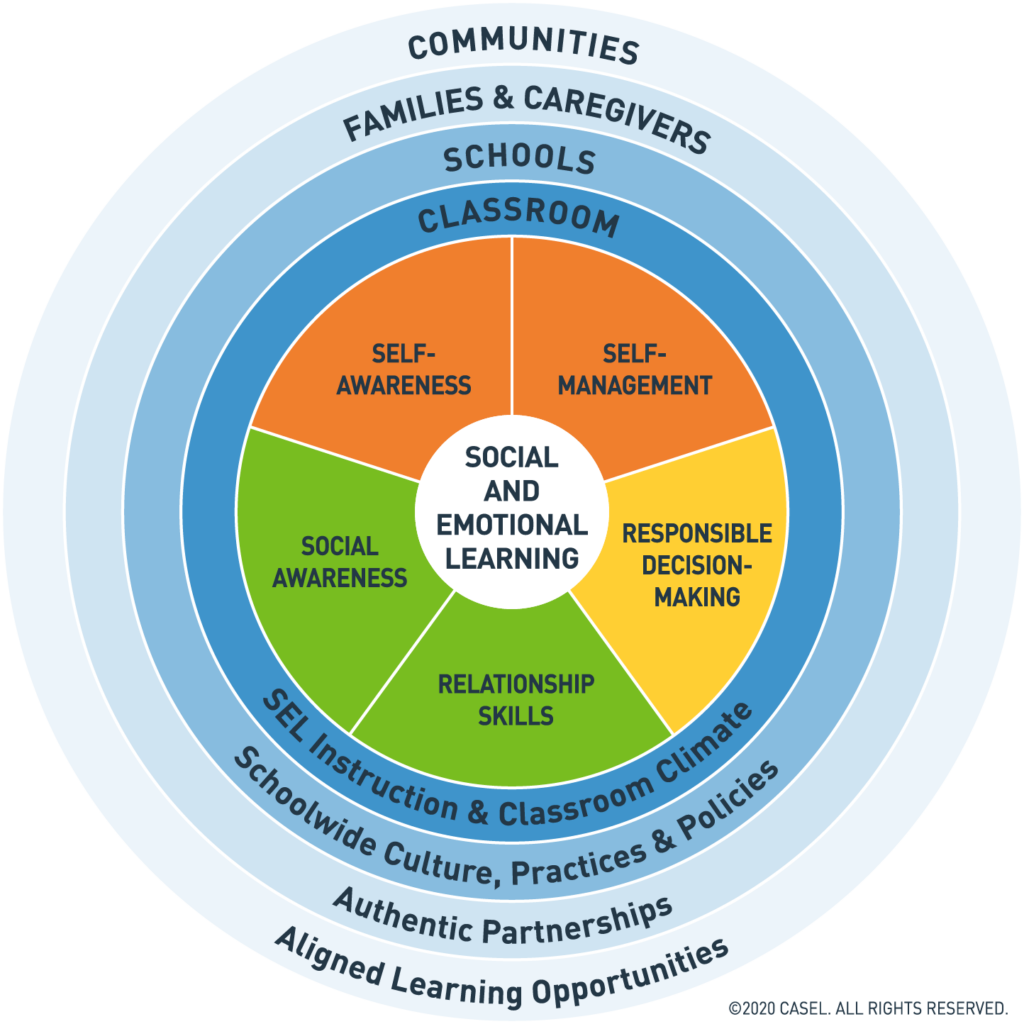
A “side effect” of students cultivating SEL skills is academic growth (and here) in the content areas.
- Perseverance and growth mindset in Self-Awareness teach students to work through academic difficulties.
- The organizational skills of Self-Management lead to quality work completed on time.
- Social Awareness helps students analyze situations from multiple perspectives.
- Communication and collaboration of Relationship Skills enables students to exchange complex ideas in written and verbal forms.
- The problem solving of Responsible Decision-Making leads to deep understanding of academic content and its application to real world problems.
SEL competencies are intricately intertwined with academic skills and are at the heart of deeper learning.
Returning to the original situation, is this a legitimate interview question? Again, I would argue yes. My assumption, unless shown otherwise through stories and examples told, is that the teacher who thinks content is king tends to be less progressive. They probably use lecture as their primary tool to “deliver” content to their class and may be skeptical of PBL. So the explanation that a prospective teacher gives for their choice, not necessarily the choice itself, should reveal useful details about their pedagogy and style of teaching to determine whether they are a good fit with the school beliefs and culture.
What say you? Content or skills? Which one do you value more?
Interested in learning how you can develop SEL skills integrated in your classroom? Check out my virtual workshops this summer! I am also booking workshops with schools across the country on PBL and SEL.