Control Continuum
Who controls most classrooms? Whose voice dominates? Who decides what is learned, how it is learned, and with whom? Who determines the assessments and what they look like?
When first learning about Project Based Learning, many teachers skeptically ask me “How do I keep kids on task?” or “How do I ensure that students learn all of my content standards?” Often what they are actually questioning is “Does PBL lead to classroom chaos?”
Anarchy
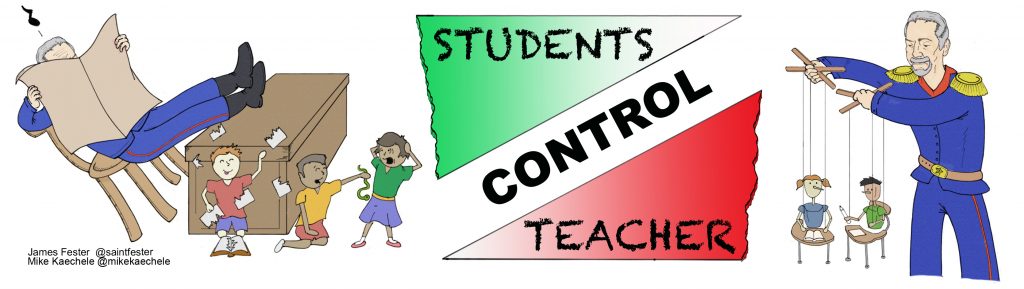
Behind these questions is a fear of losing control. Educators worry that if they allow student voice and choice, their well managed class will turn into a free for all. They don’t say it out loud, but these teachers fear Anarchy as seen on the left hand extreme of the Control Continuum with students having one hundred percent control and the teacher exerting none.
They imagine students doing whatever they feel like with the teacher asserting zero input. When educators think about inquiry based or student driven work, they wonder, “What is the teacher is doing? Just sitting back reading a book or playing a game on their phone?” They picture the teacher as a clueless babysitter ignoring a mob of spoiled rotten children. They imagine poor substitute teachers that they have observed and think “No way!”
But this is a straw man argument and one of the biggest myths about PBL. No one is advocating for Anarchy in the classroom!
Tyranny
To demonstrate how ridiculous this fear is, I want to consider the opposite extreme: Tyranny. On the right side of the Control Continuum, the teacher has one hundred percent control and the students have zero.
At this logical extreme, the teacher commands every student action. The teacher is a military dictator controlling every thought through power and fear. Students are marionettes, powerless to think or react without permission. Relationships, feelings, and emotions are irrelevant as the supreme leader dictates content into the brains of his subjects. They will obey, and they will learn at his command.
Absurdity
Just as the metaphor of teacher as all powerful dictator is absurd, so is the teacher as powerless babysitter. Student centered inquiry is NOT a free for all. It is NOT students doing whatever they feel like, whenever they feel like doing it. These analogies are a thought exercise to show that both extremes of the Control Continuum are equally absurd. No one is advocating for the style of teaching at either end. Both are straw man arguments that if they did exist somewhere would warrant firing the teacher.
But educators rarely question the right side of the continuum. What if the teacher has too much control? Does the climate of many classrooms stifle creativity and actual learning? There is not the same fear associated with the right end of the Control Continuum as with the left. A strong classroom leader (but not to the dictator extreme) was the model that many teachers experienced when they were in school and is their comfort zone.
Implicit Bias
A further danger of the fear of student voice and choice is that some teachers don’t believe that “their students” can handle self directed learning. Sometimes this is because of the age of the children or maybe their socio-economic background. This is dangerous thinking. We know that students will rise to meet expectations and vise versa (The Power of Expectations). We also know that implicit bias can prevent our students of color from being pushed as much as they should be. ALL STUDENTS can self direct their learning with proper scaffolding and support. Never sell your students short of what they can become or do!
PBL as Framework
PBL is actually the opposite of Anarchy. It is a framework, a structure, a design process for student centered learning for both the teacher and the kids. PBL has protocols to guide students through content standards while giving them voice in what and how they learn.
We will explore the what the middle of the Control Continuum looks like in a future post and reflect on where the ideal spot is for both teachers and students. But for now, can we all agree that the fear of PBL leading to chaos is a misguided myth? Don’t go to the straw man extreme of Anarchy as an excuse not to try PBL. Give it a shot and you will learn to love the process and students will excel beyond your wildest imagination!