Author: Michael Kaechele

  • Framing a Wall-an Analogy for Education

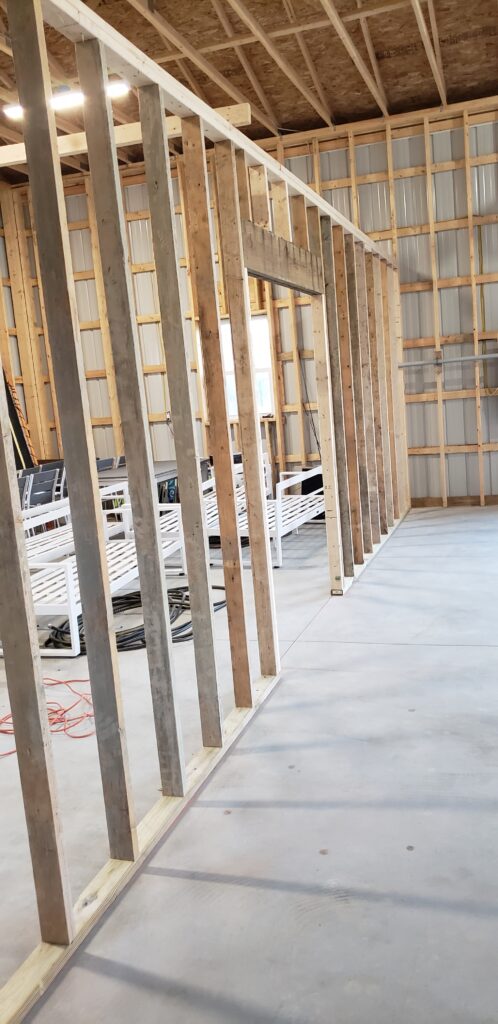
    This weekend I framed a 30 foot wall to create a future workshop area in my pole barn. It has one opening in it for a 5 foot double door. It was a fairly simple project that only took a few hours. Upon finishing, I reflected on the fact that I have been a licensed builder for 15-20 years, but this is the first time in my life that I have framed a wall, one of the most basic aspects of construction.

    Before starting, I consulted my dad to make sure that I was doing everything correctly. My dad built our house when I was an infant, but has never had a building license. He has built or helped build all kinds of projects in his life. He is a retired electrician (from General Motors, not construction) who was trained in that field. But he has no formal training in general construction.

    Who would you rather have build for you? Licensed me or my unlicensed, but experienced father?

    I do have years of concrete construction experience. I have set forms on all kinds of residential and commercial concrete projects. So it’s not like I have never swung a hammer before. But none of that is relevant to obtaining a builder’s license.

    To get my builders license, I attended about 10-15 hours of class and passed a test (the requirements are a bit more rigorous today). Every 3-5 years I have to go take a refresher course, which focuses on tax and legal requirements of my state-the business side of construction.

    When one thinks of the trades, you think of hands-on learning. But that is not how getting a builder’s license works. It is modeled after traditional schools concept of content knowledge without application. So much of the mandatory classes and specific standards are utterly useless upon graduation.

    Isn’t it time to purge school of the concentration on abstract minutia, and instead teach transferrable skills?

    Our schools, especially at the secondary level, are a plethora of discrete knowledge that is not applicable to the majority of students. We have too many mandatory classes. Students would be better served by active, hands-on classes that focus on areas of interest.

    Instead of mandating 4 years of ELA and math and 3 years of science and social studies with narrowly defined options, kids should get to choose applied alternatives. Classes such as engineering, computer science, graphic design, journalism, construction, medicine, etc.. should not be electives, but should form strands of interest that students can choose to satisfy core requirements. Let’s shift teaching and learning to applied application of content knowledge.

    We lose too many kids due to boredom and apathy towards the irrelevance of our content. It’s time to change to a model that embraces student interests and authentic questions. Let’s give kids some literal hammers and nails and move away from disconnected ideas to practical content that kids can use the rest of their lives.

    Questions? Interested in SEL and PBL workshops or consulting?  Connect with me at  michaelkaechele.com or @mikekaechele.

  • Change the Setting to Change the Mindset

    When we start talking about hot topics, people immediately take sides and get defensive. Most people, let alone students, struggle being truly empathetic and looking at a situation from multiple points of view. Everyone understands their own point of view and oftentimes think that they grasp the opposite side, but usually they don’t. This leads to emotional debates that only entrench people more deeply in their positions. Teaching the SEL competency of Social Awareness is vital if we want to heal divisions in our country and world. We need to build empathy in all of our students.

    How can we talk about important issues without the conversation breaking down into unproductive arguments?

    Once I shared a news article with my students about U.S. soldiers torturing Iraqis at Abu Ghraib prison. But instead of giving them the actual article, I copied and pasted it into a GDoc and changed the setting of the story. I substituted China for the United States and Tibet for Iraq. We read and discussed how horrible the Chinese actions were. I wanted students to commit emotionally to judgement before I revealed that there was something not true about it. Eventually I told them that it wasn’t really about China in Tibet, but the U.S. in Iraq, and gave them the link to the actual article online. Then we looked online at the disgraceful pictures of Abu Ghraib (warning many are graphic). Since I teach thematically, students immediately made the connections to other U.S. atrocities that we had previously studied in the Moros Massacre (Samuel Clemons’ commentary) and My Lai Massacre.

    This bit of deception helped open the minds of some students who initially would have been resistance to any critique of the U.S. military. It allowed them to take their jingoism out of their first impression of the event and evaluate the facts without their instinctive bias. In the end, students were able to more deeply understand why America is unpopular in certain parts of the world.

    A while back, I heard about (don’t remember where) teachers in Israel using “The Troubles” in Ireland to build empathy in their students by studying the complexities of religious (Protestant vs. Catholic) and ethnic (Irish vs. British) strife in another part of the world. The conflict in their own country was too personal and close at hand for students to consider objectively. But by first looking at similar issues abroad, students were able to apply it back to themselves. I think this is a genius approach to teaching empathy.

    This week I listened to Malcolm Gladwell’s Revisionist History Presents: The Limits of Power, an excerpt from his book David and Goliath. This podcast episode focuses on the very topic of escalation between the the Protestants and Catholics in 1970’s Ireland and how the British got involved, and I think that it can be applied to more than Israeli / Palestinian conflict.

    Gladwell explains that a paper, Rebellion and Authority from Leites and Wolf argued that economics was the key factor in dealing with rebellions. It was (still is???) the primary viewpoint of governments and law enforcement at the time. Basically use force to make insurgents feel pain, and they will comply. The feelings and emotions of the people are irrelevant. Gladwell’s excellent storytelling demonstrates the fallacy of this theory (Sidenote: this theory also was behind the U.S. strategy in Vietnam).

    Of course, he has the American struggle for equality and full civil rights in mind, when he wrote this chapter of his book and the parallels are obvious. This podcast would be great to use with students and have them first analyze “The Troubles” and then apply their conclusions to the Black Lives Matter movement and other resistant movements.

    Sometimes we need to change the setting to change the mindset!

    CASEL has recently updated its competencies to reflect the importance of equity. Social Awareness now includes sub categories:

    • Taking others’ perspectives
    • Recognizing strengths in others
    • Demonstrating empathy and compassion
    • Showing concern for the feelings of others
    • Understanding and expressing gratitude
    • Identifying diverse social norms, including unjust ones
    • Recognizing situational demands and opportunities
    • Understanding the influences of organizations and systems on behavior

    I think one of the most important additions is the last bullet point. We need to teach students the legacy of systematic racism. History is not just individuals making decisions, but huge, powerful systems that control and limit options for the disadvantaged. In the United States, public schools are one of these systems. And when it comes to “identifying diverse social norms, including unjust ones,” it is often easier to critique another country than one’s own. Try using “neutral” international settings to build consensus before engaging in partisan domestic issues. The future of democracy may depend on our ability to develop Social Awareness in the next generation!