Tag: pbl

  • Speaker for the Dead

    Before break we finished the last of our wars/foreign policy projects. We looked at the time period of post-Cold War to present with the defining event being 9/11. The driving question was “Why did 9/11 happen and how should we respond to terrorism?” We also read Ender’s Game. 

    For our entry event we read an article to students about China capturing and torturing Tibetan citizens including some shockingly crude details. Students were disturbed by this, but then we revealed that we had doctored the article. Actually it was about what the United States did at Abu Ghraib to Iraqis, not about China at all. This set up part of what we wanted students to do for this project, look at events from the viewpoint of outside of America.

    We then jigsawed looking at American interventions post Cold War. We did go back into the 1970’s for American actions in the Middle East to give students the perspective of how involved we have been in that part of the world. We also used the graphic novel version of the 9/11 Commission report to review the causes, events, and immediate after effects of 9/11.
    1476692_651085418273528_1237914580_n
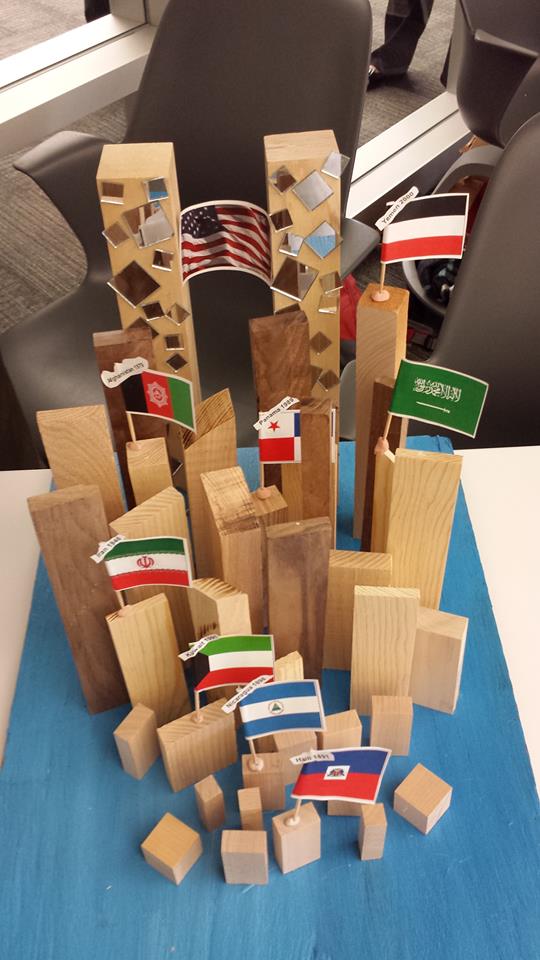
    Flags of countries with the years that America “intervened” in leading up to 9/11.

    For the final phase of the project we applied Ender’s Game to the events (warning the next paragraphs contains spoilers for the book and the movie).  In the book Ender unknowingly destroys the Bugger’s home world in a genocide. But unknown to anyone else, Ender finds an egg containing a queen Bugger for a future colony. More importantly, the Buggers communicate telepathically to Ender and he learns their whole history. Ender feels terrible that he destroyed them and part of his healing is that he anonymously writes their complete history as “Speaker for the Dead.” This book becomes popular through out the universe leading to a sort of religion. People become Speakers for the Dead and travel around and give eulogies at funerals where they explain people’s lives in totality, the good, bad and the ugly. People find the truth very liberating.

    The final product was for students to create a monument design for 9/11 as “Speaker for the Dead.” We wanted students to create a design that was complex representing the totality of the events, including causes and U.S. actions afterward in Iraq and Afghanistan. We spent a few days looking at existing monuments and the symbolism behind them. Many students struggled with interpreting symbolism at first, but by the time they designed their own monument it was making sense to them. Students created some great designs, some of them drawings or physical models and other in Mine craft or Sketchup (some examples on our Face Book page).  Not all of them “look” great as far as the models go, but their explanations of the symbolism behind them demonstrated that they understand both the social studies and ELA content and applied it deeply. Most important to me is that we had some good conversations about how America can look to solve future problems with out being a bully, over bearing mother, or supercop of the world.
  • My Great Depression Dilemma

    http://lcweb2.loc.gov/pnp/ppmsc/00200/00234r.jpg
    http://lcweb2.loc.gov/pnp/ppmsc/00200/00234r.jpg

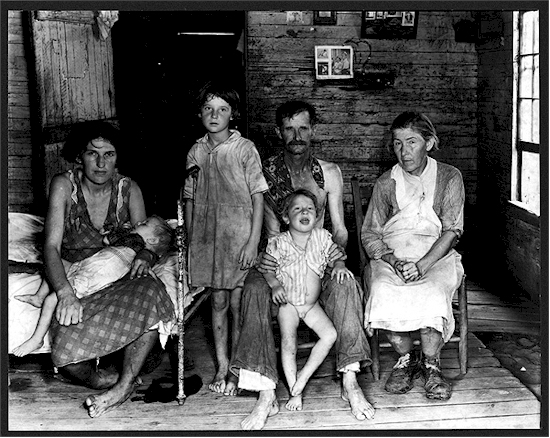
    I have been tweeting out some of my thoughts about the Great Depression as that will be our next project. I think it is a very interesting and important time period to analyze. The causes, attempted “fixes”, and how it ended are debated among historians and economists. The viewpoints usually reflect the political bias of the historian/economist of conservative, liberal, or libertarian. The other fact that has increased its importance was the bursting of the stock market from the internet bubble and housing bubble in recent years. How to keep the economy running and the role of government in both the economy and regulation of business are very current topics that the Great Depression should shed light on.

    The controversial nature of these topics make them perfect for PBL. I imagine essential questions such as:

    • What was the primary cause of the Great Depression? Defend it against other other lesser causes.
    • Why was the Great Depression global?
    • Were Hoover’s or Roosevelt’s policies effective? Did their policies shorten or extend the length of the Great Depression? Defend with specific examples and compare and contrast the presidents.
    • Was Hoover really laissez faire?
    • Is deficit government spending an effective policy during depressions and recessions?
    • How should we define Depression vs. Recession? How should we define when GD ended? by GNP? unemployment rates? financial levels of families? income gaps and disparities?
    • Is war “good” for an economy?
    • When did the Great Depression end and why? New Deal vs. start of WWII vs. end of WWII vs. other?

    But now let me share my struggles. First of all in order to give fair answers to most of these questions or even consider them one needs a background in economics. My students have not taken that class yet making many of these concepts very challenging for most of them. Also due to the challenge of the economics, many students also find them boring. On a personal note, although I have a solid math background and understand basic economics, I think I need a much deeper level of economics to give these topics justice. I mean these topics are so debated by experts that I feel it is difficult to answer these questions for myself.

    That leads to my biggest problem with this topic. I am not afraid to teach or admit to students that I do not have it all figured out yet, but what I really need are high school level resources from the various viewpoints. A mixture of primary and secondary sources that explain the major economic theories, their biases, strengths, and weaknesses would be great. Of course textbooks (which we don’t have anyway) are not much help in this. I envision comparison charts that summarize the major viewpoints along with primary sources including data, political cartoons, quotes, etc. Then I could give the essential questions and resources to students and turn them loose to come up with their own opinions.

    So anyone have suggestions on student friendly resources particularly defining the major economic views?