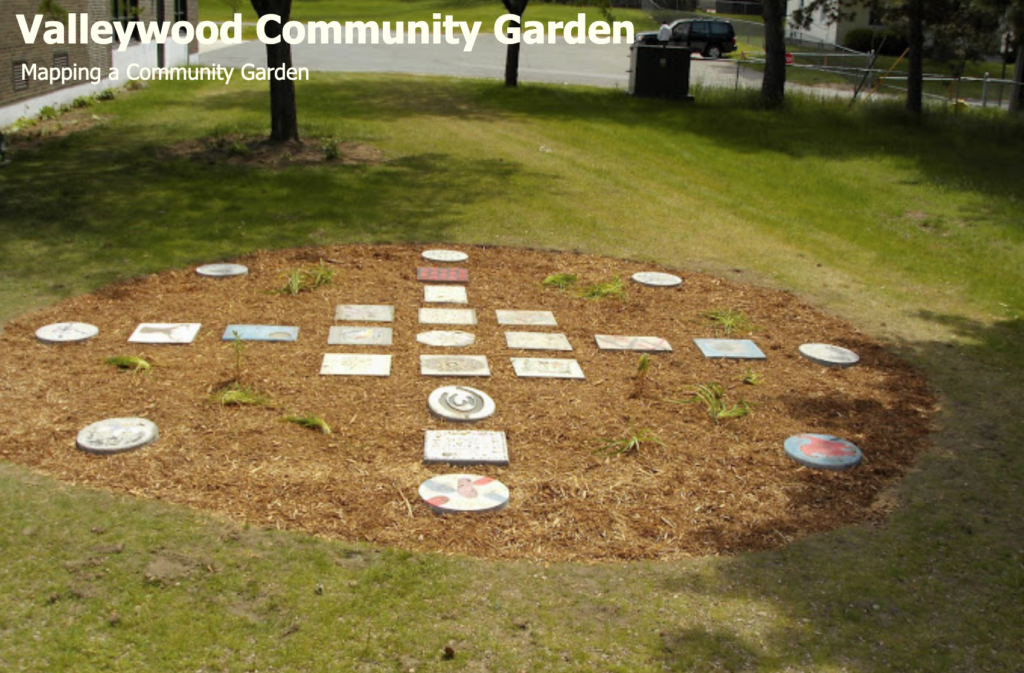
Our art teacher, Kim, and I combined our art and technology classes for the final quarter of this year and team-taught a landscaping class. This post is a reflection on the class, good and bad, looking towards another version of it next year. It was challenging, frustrating, and rewarding at the same time. We had a general idea of what we wanted to do and accomplish, but we really wanted the students to have as much a voice as possible in the class. Therefore it was difficult to “plan” because we really wanted to leave that to the students.
We started the class knowing that we would use my background in concrete construction to have the students build some kind of decorative pavers in a garden space that we would create outside of our rooms. We tried to spend time in research with books and the Internet. Kim taught them about Georgia O’Keeffe and Frank Lloyd Wright. The students drew the space from a two-point perspective and as a blueprint on graph paper. The students really struggled with the abstractness and ambiguity of the project.
We realized the students could not focus on the big picture of the project, so we switched approaches and had the students draw life size versions of their personal tiles. We made some guidelines for them that the tiles had to be based on nature. The students really took off with great ideas.
While they worked on drawings in Kim’s room, I brought small groups to my room and the students built their forms. They choose the shapes, measured, cut, drilled, and screwed the forms together. For many of them it was a first time using any of these basic tools. It was great to see some of the students who had some skills in this area jump in and take charge.
Next we began pouring the pavers. Concrete is a challenging material because of the time constraints. You can not just pack up at the end of the hour and finish the next day. So we were able to pour 2-3 each day taking over ten pour days to finish. The students mixed the concrete with a drill, poured it in the forms and finished the concrete. A few days later we stripped the forms.
The process of figuring out the layout design of the tiles was one of my favorite parts of the project. Now that they had the tiles they could “see” the problem of layout. We cut out life-size cardboard shapes of each tile and they wrote their names on them. Then we went out side and told them to lay them out. Then we talked about how it looked and they edited by moving them until they “found” their design. This concrete, no pun intended, process of design was much easier for middle school students than trying to create something on a blueprint before they even really understood what they were making. We took pictures of the cardboard placement so we could remember when we bought out the real pavers.
The absolute best part of this project was seeing the skills of some of our hands-on kids validated at school. They may struggle in traditional classes, but they were the leaders of our class and you could see their self-esteem rise. They worked hard and were proud of their results. Another great part of the project was our blog at http://vwoodgarden.blogspot.com/ Students wrote about their individual tiles and we posted it next to a picture of their tile. The students were so impressed by all the dots on the clustrmap on the first day (thanks to my PLN on twitter!)
As I move to a paperless classroom, I am reminded the most important part is students. I have always emphasized project-based learning that is based on collaboration and problem-solving. Next year we plan to have the students design and build benches and some sculpture stands. We are also going to have students collect food scraps from the cafeteria and start a compost pile.Of course as has been said many times before, learning is messy, but so worth it. The students are proud to leave behind this contribution to their school.
Ok readers, how will you be creative and challenge students in real world ways next year??? Kim and I asked ourselves what are we doing sometimes and this was by far the class that took the most energy and planning. It was hard work, but oh so worth it!